

Our Landlord EPC consultancy service offers a comprehensive assessment of your property, going beyond the standard recommendations found on an EPC certificate. We provide expert, tailored advice to align with your specific goals before any work begins. We can guide you in making informed decisions.
The objective is to help you achieve an EPC “C” rating or higher in the most cost-effective way. We can evaluate multiple energy improvement options to identify those that deliver the best results and those that are less effective.
This approach empowers you to control your EPC rating by selecting energy upgrades that best suit your needs and budget. Whether you’re planning a full property refurbishment or just a few targeted improvements, this service is highly recommended for anyone aiming to achieve an EPC C rating or above while minimizing costs.
Landlords should be considering four things to get an EPC “C” before 1 October 2030:
The sections below explore these options in more depth.
The way EPCs are calculated has regularly changed since its introduction in 2007. The changes reflect updates in building regulations, fuel price changes, improvements in technology and some new features added and others removed. The latest EER: EPC regulations (RdSAP 10 EER: EPC – 15 June 2025)
FIND YOUR EXISTING EPC
Follow this link to check if you have an existing EPC rating on the governments public online EPC register.
DO NOT USE OLD EPC RECOMMENDATIONS
Whilst the old EPC can still provide some useful information about the property, It’s important NOT to make detailed decisions based on EPC recommendations more than 6 months old.
For example what may have been a state of the art high efficiency gas boiler, recommended level of loft insulation or the latest double glazing when the EPC was originally undertaken, these elements may now be considered poor.
Over the years landlords may have made improvements to the property that are not reflected in the old EPC.
EPC HEALTH CHECK REPORT (£20)
Based on your existing EPC we offer a low cost EPC Health Check Report – This report that gives you an early stage assessment of your property in relation to the upcoming Minimum Energy Efficiency Standard (MEES) 2030 regulations.
The report is advisory in nature and is intended to help landlords:
Landlords Act Now to lock in MEES Compliance for 10 years under the current EPC rules.
Band C or above EPCs that are completed before 1 October 2029 using the current RdSAP EPC calculation method should remain valid for 10 years.
This gives landlords more time to decide whether to:
After 1 October 2029 a new calculation method called the Home Energy Model (HEM) which is expected to cost more and will have stricter regulations.
WHY COMMISSION NEW EPC
NEW EPC RATING
Below a “C” – You are not alone – An estimated that 2 million private rented properties will need some upgrade work to meet the MEES 2030 band C standards.
MEES COMPLIANCE PLAN
Based on your new EPC, we offer landlords a clear pathway for improving your property’s energy efficiency to meet MEES 2030 requirements.
With the new data collected the EPC assessor is able to go beyond standard EPC recommendations and using government approved software model scenarios to meet the landlords needs (Lowest cost, Least tenant disruption, most eco friendly etc…
The MEES Compliance Plan includes:
To encourage PRS landlords to upgrade in advance of the MEES 2030 deadline the following transition arrangements have been agreed by the Government:
TRANSITION ARRANGEMENTS
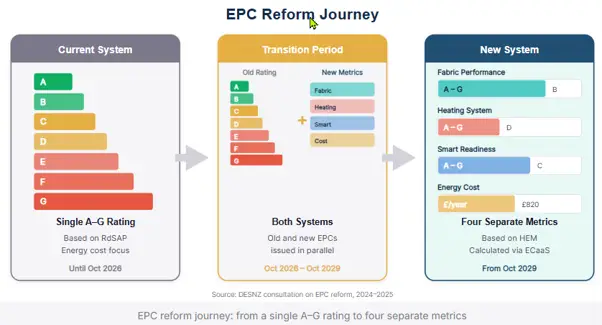
UNDERSTANDING HOW EPCs ARE CALCULATED
(EER) Energy Efficiency Rating V (HEM) Home Energy Model
EXISTING EER:EPCs (Cost Based). The existing way of measuring EPCs is based on the Energy Efficiency Rating (EER), which assesses the estimated cost of heating, lighting, and hot water in a property.
The calculation and data collection method used for new homes or conversions is called the Standard Assessment Procedure (SAP) and for existing dwellings the Reduced data SAP (RdSAP). SAP was first published in 1993 and has been updated periodically, in 1998, 2001, 2005, 2009, 2012 and SAP10.2/RdSAP10 2025, June 2026 RdSAP 10.0.0.1.
The EER will be replaced by the new Home Energy Model (HEM), a dual metric standard, on 1 October 2029, after a transition period when both metrics will be available from the end of 2026.
NEW HEM:EPC methodology for EPCs. It is a two-step methodology, that is still subject to consultation:
When a pre-1 October 2029 EPC Cs expires, landlords will need to invest in either a heat pump or solar panels, as well as having a well insulated property (although there is an exemption for wall insulation).
CURRENT MINIMUM ENERGY EFFICIENCY STANDARDS – 2026
A summary of the current MEES standards before the proposed changes come in on 1 October 2030.
We can also advise landlords registering an exemption on the PRS Exemptions Register – if they fail to meet a C by 1 Oct 2030.
MEES 2030 EXEMPTIONS – From 1 Oct 2030
Government has confirmed that, for the new EPC C standard, the cost cap will increase to £10,000 (incl. VAT) with some exemptions lasting up to 10 years. Existing principles (evidence of spend, quotations etc) will continue, with some expansion/clarification expected in the implementing regulations. The landlord can use evidence of spend from 1st October 2025 to register a ‘cost cap’ exemption.
The new/updated exemptions list:
1. COST CAP (New / £10,000 inc. VAT)
When a landlord has spent up-to or over the cost cap of £10,000 inc. VAT, or the next cheapest improvement will take the total spent on improvements, that have not previously been used for an exemption, over the cost cap of £10,000.
2. ALL RELEVANT IMPROVEMENTS MADE (No Change / valid 5 years)
Where all the “relevant energy efficiency improvements” for the property have been made (or there are none that can be made) and the property remains sub-standard.
3. HIGH COST (Amended / valid 5 years)
If the cost of making even the cheapest “recommended improvement” would exceed £10,000.
4. PROPERTY VALUE ADJUSTMENT (New / valid 10 years)
The normal spending cost cap on energy improvements of £10,000 applies to properties worth £100,000 or more. For properties under £100,000 the cost cap would be set at £10,000 or 10% of the property’s value, whichever is lower.
5. SOLID WALL INSULATION (Amended / valid 5 years)
An exemption where a landlord could choose not to install solid wall insulation, if this is the only remaining fabric measure available to bring the property up to standard against the Fabric Performance Metric. The decision will need to be fully documented.
6. NEGATIVE IMPACTS (New / valid 10 years)
Where combing two existing exemptions, additionally allows landlords to evidence when a measure would negatively impact their property. This could include some heritage properties.
7. THIRD PARTY CONSET (No change / valid 5 years or length of tenancy)
This is an existing exemption – see the government guidance.
Key points:
8. NEW LANDLORD (No Change / 6 month exemption)
If a property is purchased with tenants in place, landlords would have 6 months to comply before enforcement begins. They must officially register for an exemption, including any exemptions the previous owner had, as they do not automatically transfer to a new owner.
9. PORTFOLIO APPROACH (Still under review / valid 10 years)
For large landlords offering a cap – sill under review!
PRS EXEMPTIONS REGISTER
Key Points
PRS Exemptions Register: https://prsregister.beis.gov.uk/
Official GOV.UK Guidance: Click here
WARM HOMES LOCAL GRANT (WHLG)
A government-funded scheme delivered through local authorities providing grants to help low-income households in the private rented sector upgrade insulation and heating. Covers measures such as loft insulation, cavity wall insulation, solid wall insulation, heat pumps, and low-carbon heating systems.
Eligibility: Available to landlords whose tenants are on means-tested benefits or have a low household income. Funding is allocated to local councils – contact your local authority to check availability and apply.
https://www.gov.uk/government/publications/warm-homes-local-grant
WARM HOMES LOAN SCHEME (WHLS)
– Reduced loans up to 5%
Government £300m grant pot for a lender-led initiative designed to increase the availability of affordable finance for low-carbon home upgrades across the United Kingdom. (Bringing down typical market lending rates by 5% percentage points – i.e. 9>4%, 10>5%)
Targeting owner-occupiers and private rented sector landlords who are ‘able to borrow’ – meaning those who are motivated to install green technologies but lack the upfront savings to do so and are either deterred by the current cost of borrowing or unable to access more affordable products due to restrictive eligibility criteria.
Eligible measures include: (Whole home lending cap £35,000).
The WHLS can be used along side the Boiler Upgrade Scheme (BUS)
LOW CARBON HEATING
* Before Boiler Upgrade Scheme (BUS) is deducted
SOLAR & STORAGE
(Typical home improvement loans are currently (2026) around 8-10%. Government will put in around 20% of the value of the loan up front to reduce risk for the lender and reduce borrowing rates for 3-10 year loans by around 5% points.)
Further deatails:
https://assets.publishing.service.gov.uk/media/6a3d3847da47783d87723aeb/warm-homes-loan-scheme-scheme-rules.pdf
Great explanation from Mick Wall and Heatable.
BOILER UPGRADE SCHEME (BUS)
Boiler Upgrade Scheme Provides upfront grants to replace fossil-fuel boilers with low-carbon heating systems. Current grant levels: £7,500 for air source heat pumps, £7,500 for ground source heat pumps, and £5,000 for biomass boilers (in rural areas only). Grants are paid directly to the installer and deducted from your installation cost. Eligibility: Available to property owners in England and Wales. The property must have a valid EPC with no outstanding recommendations for loft or cavity wall insulation. Applications are made through an MCS-certified installer.
(Update: 21 July 2026)
Properties off the gas grid heated by oil or LPG can now claim the original £7,500 plus an uplift of £1,500 (£9,000). The uplift started 21 July 2026 and runs till March 2027.
https://www.gov.uk/apply-boiler-upgrade-scheme
Energy Company Obligation (ECO4)
Obligates large energy suppliers to fund energy efficiency improvements in the homes of low-income and vulnerable households. Covers insulation, heating upgrades, solar panels, and more. Works are fully or partially funded at no cost to eligible households. Eligibility: Available to tenants receiving certain benefits (e.g. Universal Credit, Pension Credit, Child Tax Credit) or referred through local authority flex criteria. Landlords must agree to allow works. Apply via your tenant’s energy supplier or through the Simple Energy Advice service.
https://www.gov.uk/energy-company-obligation
For general advice, visit: https://www.simpleenergyadvice.org.uk
Using the current EER: EPC rules up to 1 October 2029 (Draft only 29/05/2026)
"Click the step to find further information on the back"